Sangameshwara G B
 4 February 2026
 6 mins
In 2025, global climate indicators continued to reveal a widening gap between ambition and action. According to the World Meteorological Organization (WMO), 2025 was one of the warmest years on record, with average global temperatures from 2023 to 2025 surpassing the 1.5°C threshold referenced in the Paris Agreement. While current national policy trajectories remain misaligned with 1.5°C pathways, these signals have reinforced the urgency of accelerating effective climate action.
As climate scrutiny has increased globally, carbon markets have been asked to demonstrate credibility, transparency, and durability. Consequently, the market is being reshaped in favour of quality, operational rigour, and clearer alignment with long-term climate strategies.
While market value remained broadly stable, buyer behaviour, pricing signals, and project selection continued to shift toward higher standards. Taken together, last year’s trends point to a carbon market that’s moving from growth to maturity.
According to MSCI and ACLIMA, the value of the global carbon-credit market remained steady at just over USD 1.4 billion in 2025, marking the fourth consecutive year at this level. Over the same period, global carbon-credit retirements increased by approximately 3% year on year, matching the previous all-time high reached in 2021.
Rather than expanding through higher volumes alone, the market is increasingly being shaped by how credits are assessed, priced, and justified.
Global carbon-credit retirements in 2025 match previous all-time high (MtCO2e)
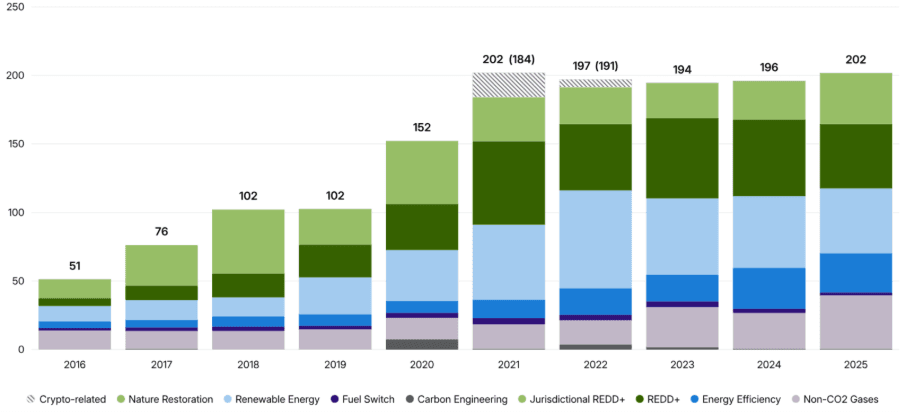
Figures include credits transferred into the California Cap-and-Trade Program. Registries covered: ACR, ART Trees, BioCarbon Standard, CAR, Carbon Standards International, Climate Forward, CDM (NDC-eligible credits only), EcoRegistry, eva, GCC, Gold Standard, Isometric, JCM, Puro Earth, UK Peatland, UK Woodland Carbon Code and Verra. Source: MSCI Carbon Markets
Rising prices for higher-quality credits have increasingly offset weaker performance among lower-quality projects. This growing bifurcation is now one of the defining characteristics of the market and signals a shift away from volume-led growth toward quality-led participation.
As of 31 December 2025, more than 10,200 carbon projects were registered across 18 major registries. During the year, these projects issued approximately 294 million tonnes of carbon-dioxide equivalent (MtCO₂e), bringing cumulative issuance since the Paris Agreement in late 2016 to over 2.6 billion credits.
On the demand side, 202 MtCO₂e of credits were retired in 2025, in line with the stable retirements trend over the past four years. Retirements were driven primarily by voluntary corporate climate strategies, alongside transfers for compliance purposes.
Companies are increasingly integrating carbon credits into structured climate strategies rather than relying on ad hoc purchases. Registry systems and standards also play a central role in enabling this shift by providing transparency, traceability, and confidence across the credit lifecycle.
Around 10% of credits retired in 2025 were linked to emissions-removal activities, with the remaining 90% derived from emissions-reduction projects. Nearly all removal-based retirements originated from nature-based projects.
In contrast, renewable-energy credits accounted for less than one-quarter of total retirements in 2025, down from over one-third in 2021 and 2022. This trend reflects growing concerns around additionality and the robustness of claims, particularly in markets where renewable energy deployment is already commercially viable.
Nature-based credits continued to dominate total volumes, but buyer demand has shifted away from legacy REDD+ projects toward improved forest management, afforestation, reforestation, and agriculture-based projects. Well-rated projects with stronger monitoring frameworks, clearer land tenure, and greater permanence assurances are increasingly favoured.
Agriculture-based projects have also expanded, supported by their potential to deliver measurable co-benefits for soil health, resilience, and livelihoods. These attributes are no longer viewed as secondary considerations, but as integral to project quality and long-term credibility.
Compliance Demand Is Quietly Growing
Compliance-driven retirements accounted for approximately 23% of total retirements in 2025, supported by programmes in jurisdictions such as California, Quebec, South Africa, and Chile. While voluntary demand continues to dominate overall market activity, compliance systems provide an important anchor for long-term demand and standard setting.
As additional compliance frameworks are developed and existing ones evolve, their interaction with voluntary markets is likely to increase, reinforcing the importance of consistent standards and robust registry oversight.
Inventory data highlights a structural imbalance in the market, where credits rated BBB or higher have been in deficit since 2023, a trend that continued for a third consecutive year in 2025. At the same time, lower-rated and unrated credits remain heavily oversupplied, with unrated credits alone contributing an estimated 88 million tonnes to inventory during the year.
This implies that the market is not short of credits, but it is short of credits that buyers have confidence in. As due diligence practices, ratings, and disclosure expectations become more embedded, confidence will continue to shape which credits clear the market and at what price.
If 2025 marked the market’s transition to maturity, the next phase will be defined by how quality is priced, how removals scale, and how capital responds.
The implications of these dynamics for pricing, forward markets, and investment signals are explored in Part 2 of this series.