Anugraha Sundaravelu
 26 May 2026
 3 mins
Uttar Pradesh (UP) consumed 111 lakh metric tonnes of fertilizer in FY 2024-25. That’s one state consuming nearly 18.9% of the entire country's fertilizer use. UP has roughly 17% of India's net sown area. So, this level of consumption is particularly disproportionate.
To put this in perspective, Maharashtra, which ranks second, used around 63.9 LMT in the same period. UP’s number is not just large; it is structurally disproportionate and it has been for years.
According to data from Digital Sansad, total fertilizer consumption across India’s top 25 states from the years 2020-25, shows Uttar Pradesh consistently ranking at the top in every year.
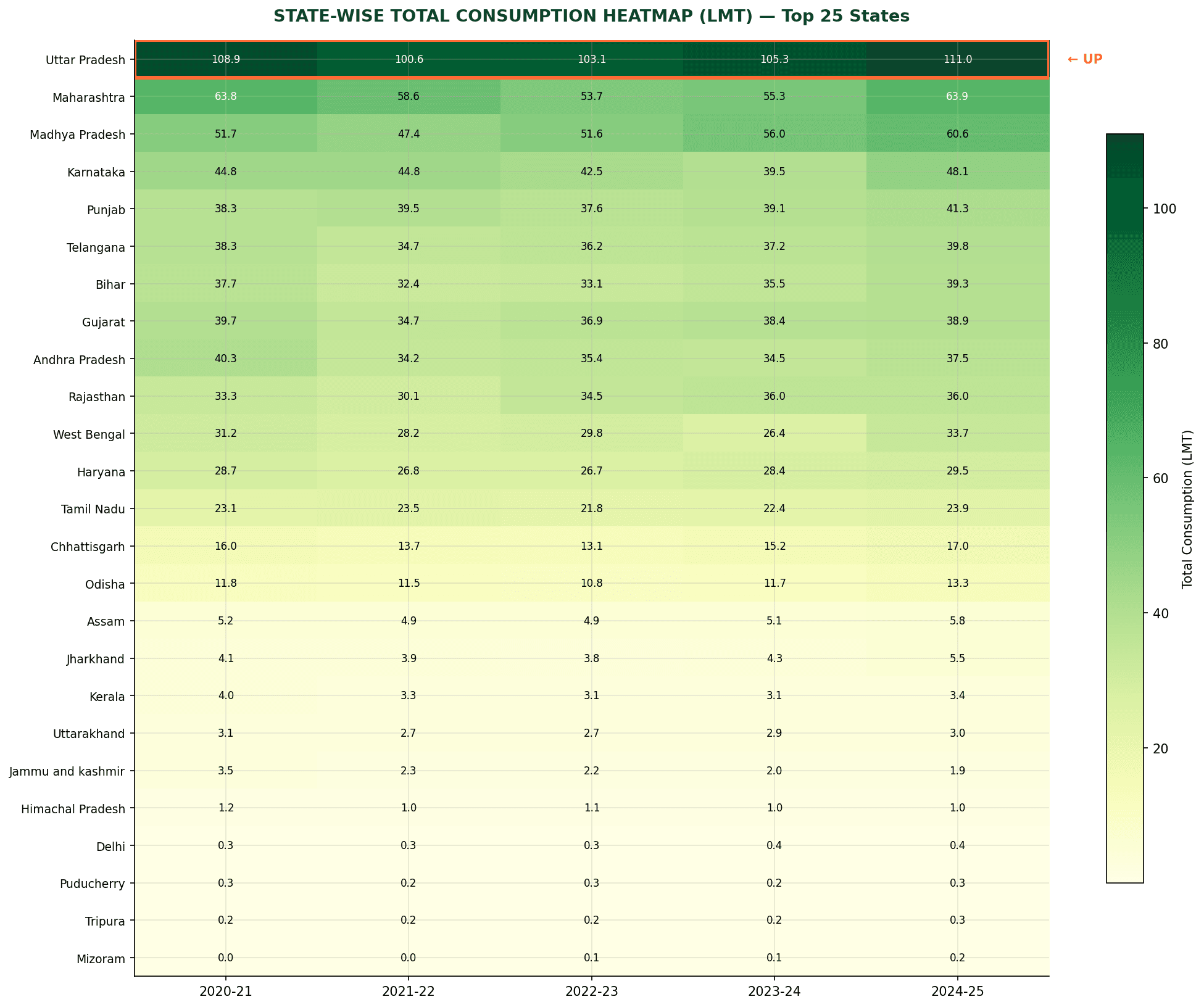
Source: Digital Sansad
Over the past five years, UP has consumed 105.7 LMT on average, revealing a deeply entrenched dependence on fertilizers that could have far-reaching consequences for soil health, crop yield and farmer incomes.
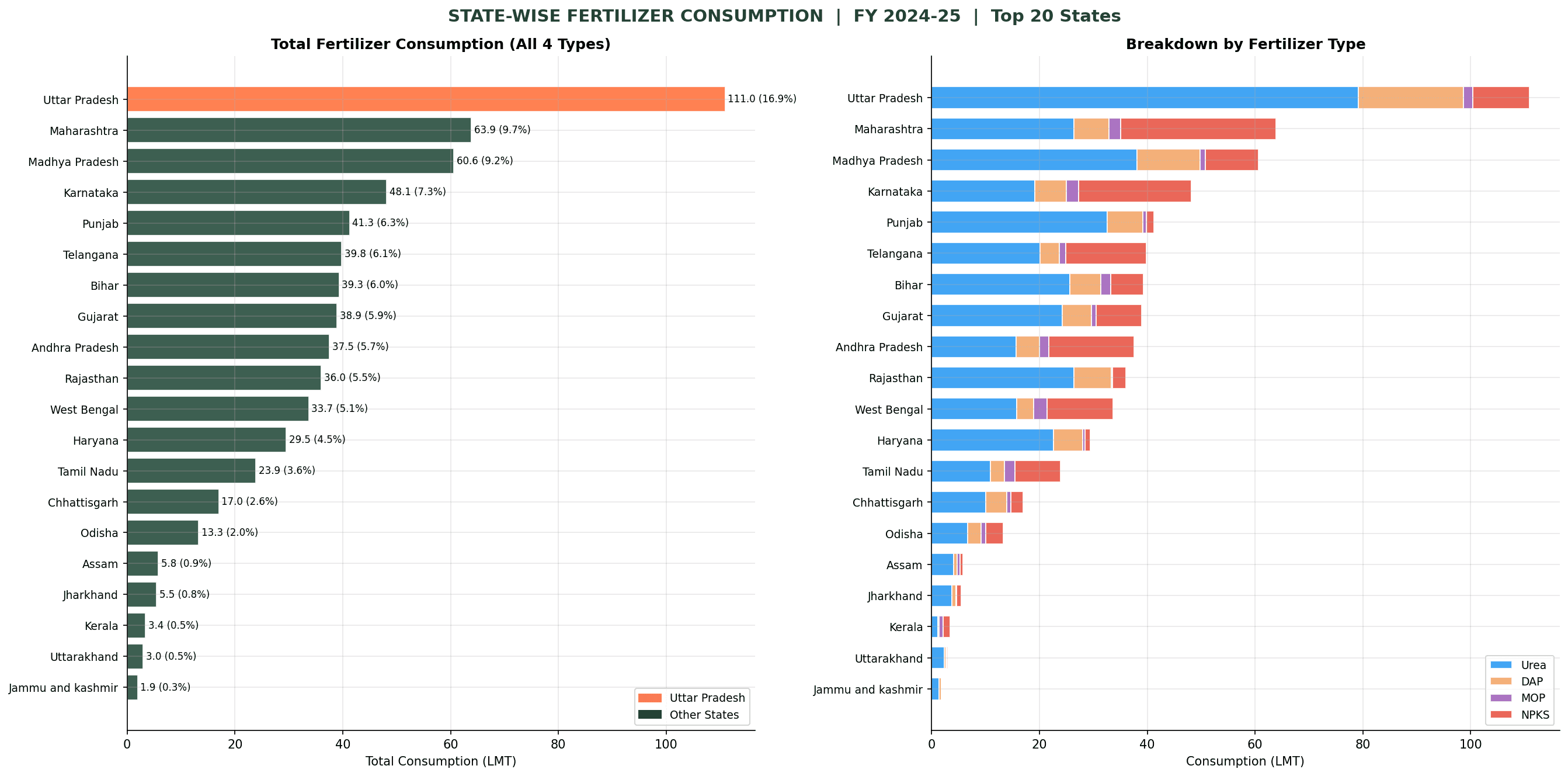
Source: Digital Sansad
Breaking down the data by fertilizer type, tells a more specific story. Urea dominates UP’s consumption profile, followed by Diammonium Phosphate (DAP). Both of which are nitrogen and phosphorus-heavy inputs. Interestingly, both are subsidised and are being applied, in many parts of UP, at rates that are not matched to what the soil or the crop actually needs.
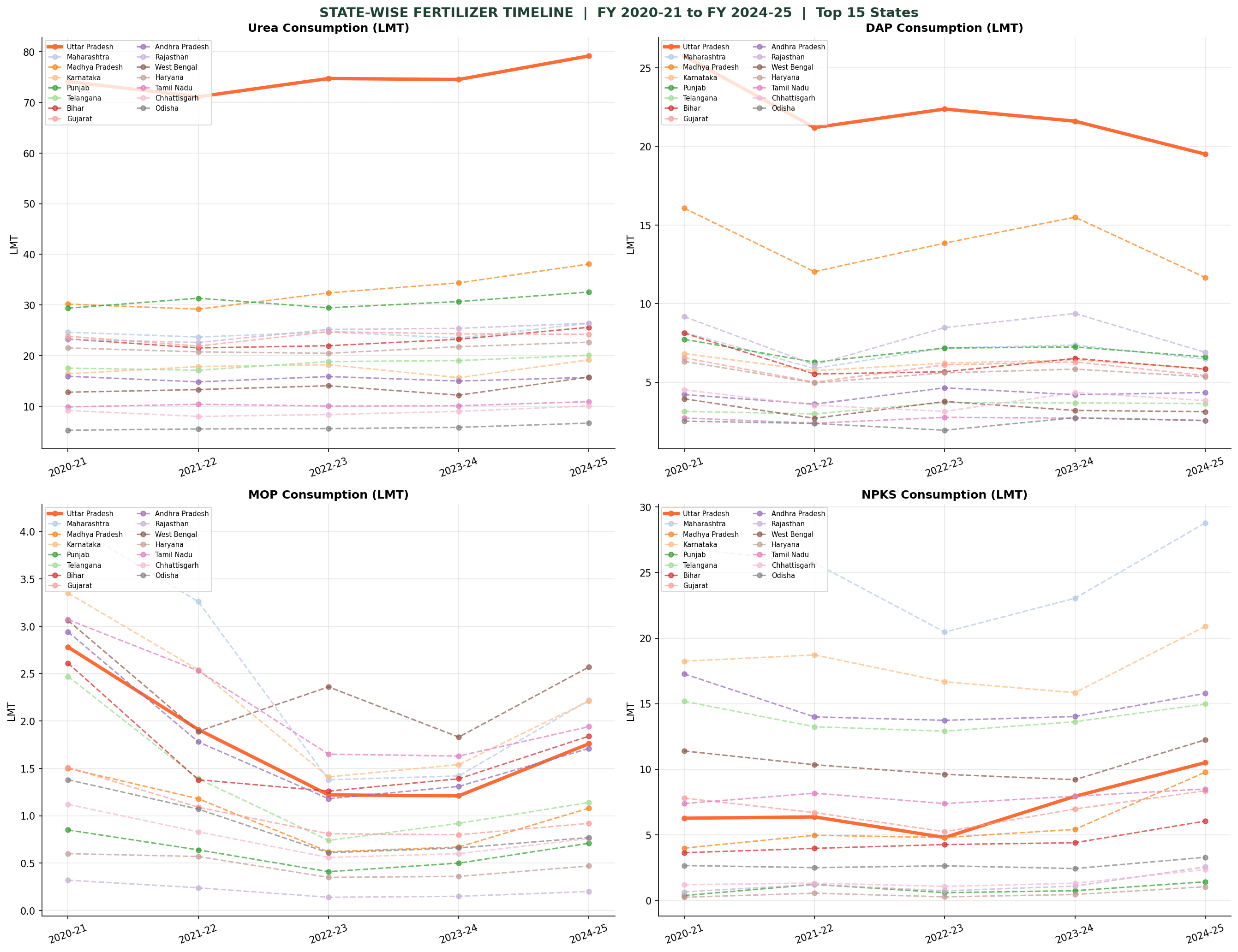
The current scenario reflects the realities of the agricultural systems and incentives farmers operate within, rather than a lack of care on their part.
"Urea in India is heavily subsidised, which means the price signal a farmer receives at the point of purchase is disconnected from the actual cost of use. Naturally, when something is cheap, farmers end up using more of it," explained G Anandan, Senior Expert, AFOLU Projects at ProClime.
The second factor is how fertilizers are packaged and sold.
"Fertilizer bags come in fixed quantities. So, a farmer growing wheat on a two-hectare plot does not have ready access to precise application guidance calibrated to their farm. So, they apply what they have i.e. the whole bag, not a measured portion."
Add to this the fact that most smallholders in UP have not had an actionable soil health assessment done on their land. The government launched the Soil Health Card scheme in 2015, but access to the cards, let alone the agronomic follow-through, has been uneven. Farmers are making input decisions based on habit, oral wisdom, and what the fertilizer dealer recommends; not on what the soil is actually telling them.
In addition, UP’s wheat-rice double cropping system compounds the fertilizer expenditure: once for the kharif rice and next for the rabi wheat, season after season on the same land.
The economic cost of overuse is not immediately visible to the farmer as the yield does not drop immediately. So, when the next season arrives, the same cycle repeats. In the short run, a little extra fertilizer might seem harmless but over the years, this overuse adds up. The cost becomes visible over time, and by then it has compounded.
According to a report by the Indian Council for Research on International Economic Relations (ICRIER), India was facing a “clear and troubling decline” in key soil quality indicators over time.
Nitrogen-heavy fertilizers, applied in excess, acidify soil over multiple cropping cycles. As soil pH drops, nutrient availability decreases. The organic matter that holds moisture and supports microbial activity is depleted. The result is a slow deterioration of the land’s productive capacity: the same input producing gradually less output, year on year.
Farmers respond to declining yields by adding more fertilizer, which accelerates soil degradation further. This is the vicious cycle that overuse creates, and it is not visible in a single season’s yield or accounts.
Fertilizer overuse has a greenhouse gas dimension that India’s agriculture sector has largely not had to account for. Excess nitrogen in soil that crops do not absorb is converted by soil bacteria into nitrous oxide, or N2O. N2O is a greenhouse gas with roughly 273 times the warming potential of CO2 over a 100-year period (IPCC AR6, 2021). India is one of the world’s largest agricultural N2O emitters, mainly driven by urea over-application.
"Flooded rice paddies produce methane, another potent greenhouse gas. The standard paddy management practice of keeping fields continuously waterlogged through the growing season increases methane production from the soil," explained Anandan.
Finally, at the end of the season, when the crop residue is left standing with no clear use and burning it is the cheapest way to clear the field for the next cycle, the biomass goes up in smoke. With it goes the nitrogen stored in the straw, the carbon, and a visible plume of particulates that is trackable from satellite imagery above the Indo-Gangetic Plain every October and November.
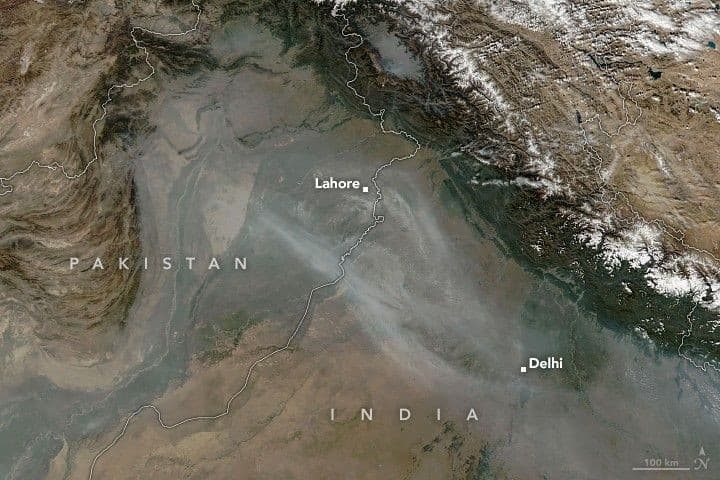
These costs are real but they have not been formally priced into what it costs to grow food in Uttar Pradesh.
Sustainable Agriculture Land Management, or SALM, is a set of practices that address these problems at the farm level. Three of them are directly relevant to UP.
Instead of applying a full load of fertilizer before or at planting, it is applied at the growth stages when the crop can actually absorb it. The same input, distributed differently, produces better uptake, less runoff, and less soil accumulation. For most smallholders, this requires a simple decision tool: a crop-stage schedule, or a leaf colour chart for assessing nitrogen status in rice. Low-tech, practical, and directly tied to input savings.
In rice cultivation, AWD means allowing the paddy field to partially dry between irrigation cycles rather than keeping it continuously flooded. The soil alternates between wet and dry conditions across the growing season. While the methane reduction from this single practice is significant, the direct benefit to farmers is just as tangible. Switching from traditional flood irrigation (5–6 hours per acre) to AWD cuts irrigation time to just 1 hour per acre, offering a 70% reduction that translates into fuel and electricity cost savings.
Farmers stop burning not because they were told to, but because the alternative pays. Crop residue like rice straw and wheat stubble can be used as compost feedstock, mulch, or as raw material for biochar production. Currently, the economics of burning makes the most sense to a farmer but when there is a collection mechanism, a buyer, or an application use for the residue, the equation changes.
The economics of SALM has the potential to go from cost-saving to income-generating as each of these practices reduces greenhouse gas emissions relative to conventional farming. Those reductions can be measured, verified, and registered as carbon credits under international standards. A farmer who reduces methane from paddy fields, reduces N2O from soil, and stops burning residue is generating verified climate impact. In the voluntary carbon market, that impact has value.
"What sets SALM apart is that rather than asking farmers to make changes with no visible return, it creates a new income stream from practices that also reduce their costs," added Anandan.
ProClime is currently working with the Government of Uttar Pradesh on a Sustainable Agriculture Land Management programme covering approximately 778,000 farmer holdings. Anchored by IIT Roorkee's scientific framework and the Uttar Pradesh Agriculture Department's on-the-ground reach, it brings together institutional strength to drive implementation at scale.
The 111 lakh metric tonnes of fertilizer that goes onto UP’s soil every year is a consequence of how farming in UP is currently structured using subsidised inputs, limited soil guidance and no financial incentive to reduce.
Only by changing the incentive structure can the number change. SALM is the mechanism for doing that at scale. Not because it asks farmers to farm differently as an act of environmental conscience, but because it makes the economics of sustainable farming add up.
ProClime is a full-stack climate company working across India, Sri Lanka, Nepal and Bangladesh. Our work in sustainable agriculture supports smallholder farmers in accessing carbon markets through verified land management programmes.
Read more about the UP SALM programme: https://www.proclime.world/key-announcement/pro-clime-named-largest-industry-partner-in-india-s-first-state-level-carbon-credit-programme-for-farmers